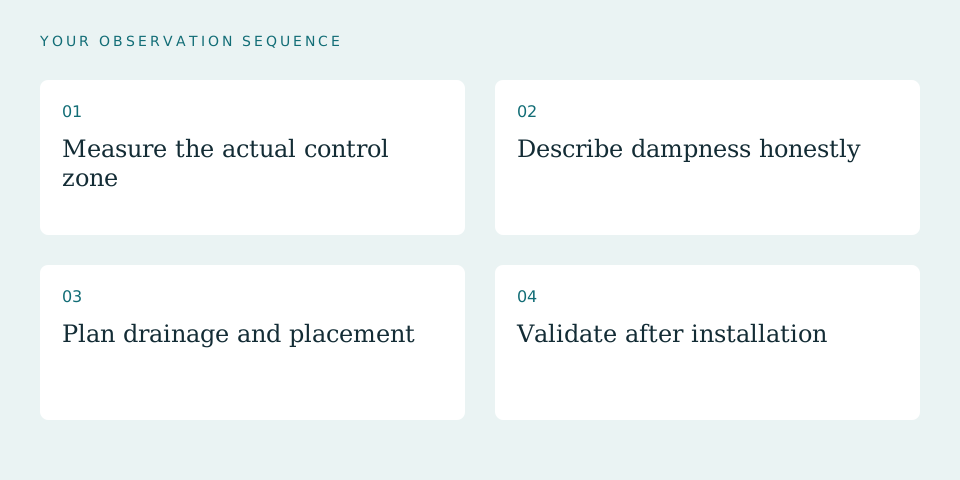
01Measure the actual control zone
Measure the length and width of the connected space the appliance must serve. Include adjoining rooms only when air can move freely between them. Low doors, closed storage rooms, and divided crawl spaces can behave as separate zones.
Use the sizing tool as a planning screen, then compare its output with the current manufacturer table for the model and test standard shown on the label.
For the initial comparison, ENERGY STAR publishes a broad table based on room area and relative humidity before dehumidification. It is a reference rather than a continuously scaling formula. A very large or partitioned space needs current manufacturer guidance; the “plus” sign in the larger-room column is not a precise equipment specification.
02Describe dampness honestly
A mildly humid room, visible condensation, and active water intrusion are not equivalent loads. Note musty odor, wet walls, dripping pipes, recent flooding, laundry drying, and outdoor-air entry. Fix liquid-water sources first.
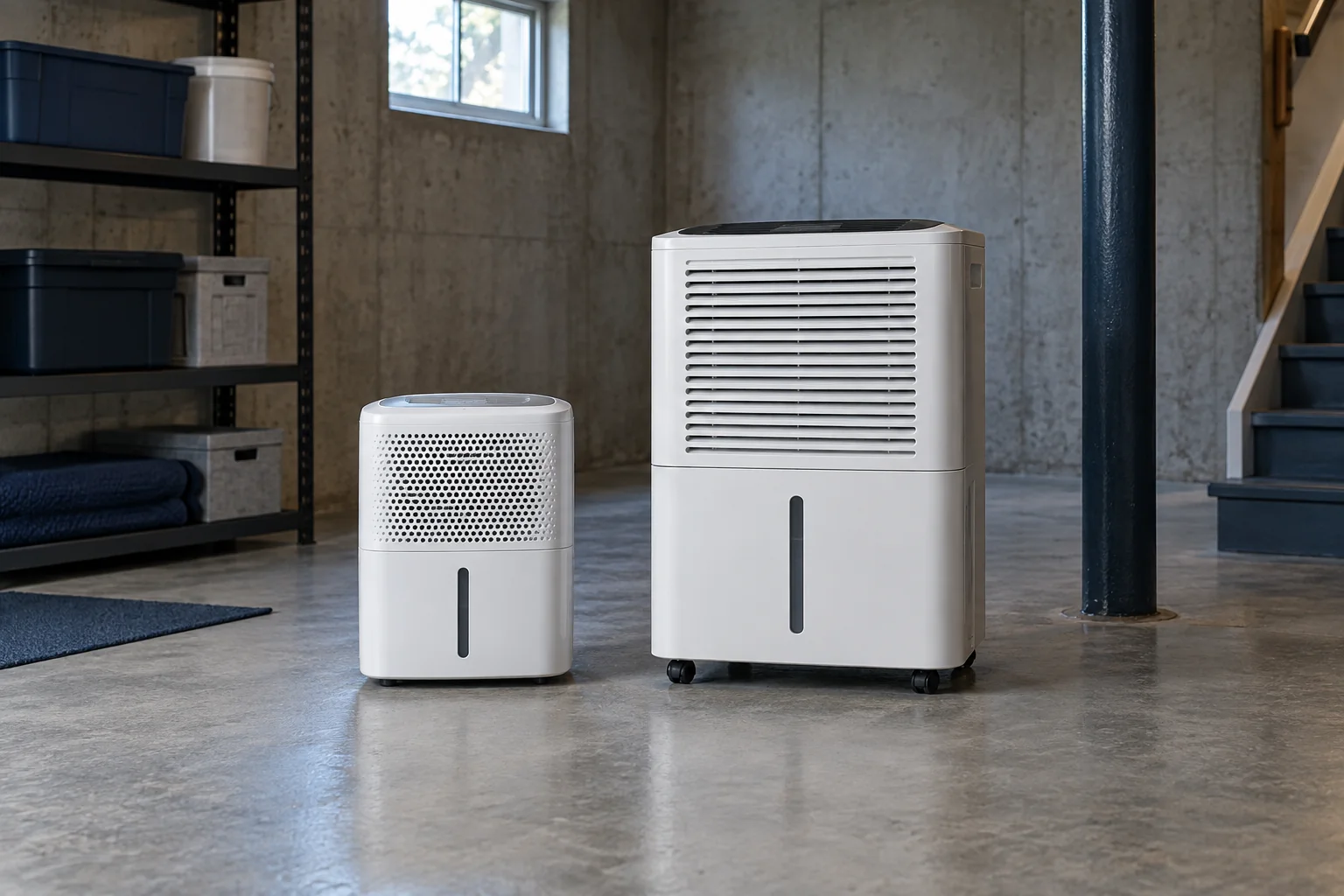
A larger unit may remove water faster, but poor drainage, blocked airflow, low temperature, or short cycling can still prevent good control.
Related check: A Dehumidifier Buying Checklist That Goes Beyond Pint Ratings →
03Plan drainage and placement
Continuous drainage must follow the appliance instructions. Confirm hose slope, pump requirements, drain location, and freeze risk. Keep required clearance around the intake and outlet, and use an appropriate electrical circuit.
Never use an unattended drainage or electrical arrangement that conflicts with manufacturer instructions or local requirements.
04Validate after installation
Measure humidity away from the outlet and compare multiple locations. Record the starting humidity, water removal, and time required to reach the target. If the reading near the unit improves but a remote area stays damp, airflow or zoning may be the limitation.
Persistent moisture despite correct operation is a reason to revisit drainage, air leakage, or hidden water—not simply to keep increasing capacity.
ENERGY STAR capacity reference, in US pints per day
| Condition before use | Under 2,000 sq ft | Over 2,000 sq ft |
|---|---|---|
| Slightly / moderately damp · 50–75% RH | 20–30 | 30+ |
| Very damp · 75–90% RH | 25–40 | 40+ |
| Wet · 90–100% RH | 30–50 | 50+ |
The source leaves exactly 2,000 sq ft unspecified and overlaps RH band endpoints. Confirm boundary cases with manufacturer guidance. Active water entry needs source repair, regardless of the table.
Sources & editorial method
The tool provides a planning band, not a product certification. Always verify the current model specification and test standard.
AI-assisted editorial content based on the linked references. Read our methods and review limitations.